Saturday, July 6, 2024

Nonfiction and Biography


Funny Bones Posada and His Day of the Dead Calaveras
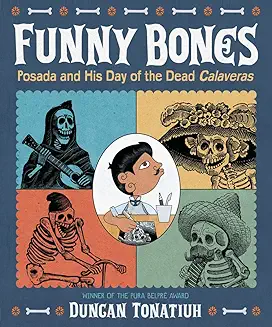


Tonathiu, Duncan. 2015. Funny Bones Posada and His Day of the Dead Calaveras. Ill. by Christopher Myers. Abrams Books for Young Readers. New York, NY. ISBN 978-1419716478


PLOT SUMMARY


Mexico celebrates many cultural holidays that have been passed down through generations.One of these holidays is El Dia de Los Muertos. During el Dia de los Muertos celebration people remember loved ones they have lost and they set up a special altar with bright orange flowers, pan de muerto, and decorations of calaveras which means “skull” in Spanish. One of the first people to draw these calaveras and use printmaking techniques was a young man by the name of Jose Guadalupe Posada who lived in Aguascalientes, Mexico in the 1870s. At a young age he became interested in art and his creativity allowed him to pursue a career in printmaking. He decided to make thousands of these skulls as a form of political satire and to entertain the community. Many of his lithographs and engravings were used as decoration for el Dia de Muertos.


CRITICAL ANALYSIS


The cultural relevance in this book is phenomenal. This book is about the life of Jose Guadalupe Posada and how his creativity in printmaking led him to become a prolific artist especially in the creation of the famous “calaveras” and “catrinas”. The story follows Jose at a young age and continues chronologically as he moves to Mexico City with his wife and son. The information in the story shows accuracy to the dates and the historical events happening in Mexico. There is a clear sequence of events from his childhood to his death. The book’s design, colors, and festive drawings depict the cultural values of Mexico. The actual prints designed by Posadas are shown throughout the pages of the book. Part of the book has a step by step guide into the process of lithography or engraving. The writing is clear, entertaining, and descriptive detailing the life of a young Mexican artist who was later appreciated by famous painters such as Diego Rivera and French- born American painter Jean Charlot. The book includes a glossary, a bibliography, art credits, and an index.


REVIEW EXCERPTS


Booklist -"Playful but informative, this picture book offers a fascinating introduction to the artist and his work.”


Publishers Weekly-"A wealth of biographical and contextual information... it’s a valuable introduction to Posada that will leave readers thinking about the process of creating art and the social impact it can have."

School Library Journal” -The beautifully expressive Day of the Dead-inspired illustrations on heavy -paper pages sport borders of bones, grinning skeletons, and Tonatiuh's signature figures shown in profile, influenced by the ancient Mexican art of his ancestors. Simple yet effective sentences accompany step-by-step images detailing the artistic processes that Posada learned as a printer's apprentice... A stunning work, with great possibilities for lesson plans or tie-ins with Day of the Dead.”


Awards:


A ​New York Times Best Illustrated Children's Books of 2015
A Robert F. Sibert Award Winner
A Pura Belpré Illustrator Honor Book
An ALA/ALSC Notable Children's Book
NCTE Orbis Pictus Honor Book (2016)
Tomás Rivera Mexican American Children’s Book Award for Works for Younger Readers (2016),


CONNECTIONS

  • This book reminds us about the importance of cultural celebrations from different countries.
  • This book inspires others to use and share your talents with others.

Other related books:

Soldier for Equality by Duncan Tonathiu

Diego Rivera His World and Ours by Duncan Tonathiu


Activity: Have students draw calaveras and make poems to celebrate el Dia de Los Muertos. Make an altar in the classroom and bring family pictures of people who have passed.

Watch videos of how to make a lithography. Pair up with the art teacher to create your own lithographies.


***********************************************************************************


What to Do About Alice? How Alice Roosevelt Broke the Rules, Charmed the World, and Drove Her Father Teddy Crazy!
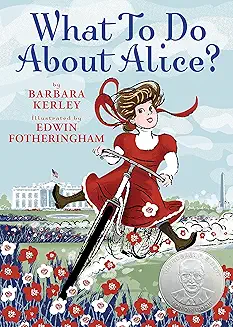


Kerley, Barbara. 2007. What To Do About Alice?: How Alice Roosevelt Broke the Rules, Charmed the World, and Drove Her Father Teddy Crazy! Scholastic Press. Ill. by Edwin Fotheringham. New York, NY .ISBN 978-0439922319

PLOT SUMMARY

This entertaining narrative biography is about the life of Alice Roosevelt. She was the daughter of Theodore Roosevelt who became president of the United States. Alice was a curious and vigorous child who enjoyed discovering new things and ideas. This was a time when girls were expected to be obedient and listen to their parents. However, Alice loved to explore and her father found it hard to keep her out of trouble. As her life continued, she traveled the world, married, and became an important advisor to her father while in office.

CRITICAL ANALYSIS

This book is about the life of Alice Roosevelt from the time she was a child to her adult life. However, it is written in a simple narrative format that engages the reader with its entertaining information. Across the pages there are certain words written in bold, all caps printed to grab the reader’s attention to the most important ideas or quotes stated by her father. . The pictures are vibrant showing Alice’s energy in her constant movement, scampering through hallways, chasing her siblings, or rolling down the hill in a bicycle. The pages show Alice’s emotions through her daily activities such as her excitement while reading books to her sadness when they advised her of going to school. The illustrator shows Alice in motion with dots connected through the page as she moves from one place to the next.

REVIEWS

Kirkus- “Theodore Roosevelt’s irrepressible oldest child receives an appropriately vivacious appreciation in this superb picture book. “From the time she was a little girl, Alice ate up the world.” Taking her thematic approach from Alice’s own self-description, Kerley’s precise text presents readers with a devilishly smart, strong-willed girl who was determined to live life on her own terms—and largely succeeded.”

Awards

Sibert Medal Nominee (2009),
Irma Black Award Nominee (2009)

CONNECTIONS
  • This book will appeal to children who are curious and like to learn and do things differently than others.
  • This book will give insights of how the children of U.S. Presidents lived while their father was in office.

Other related books:
Who Says Women Can’t Be Doctors?: The Story of Elizabeth Blackwell by Tanya Lee Stone
The House That Jane Built: A Story About Jane Addams by Tanya Lee Stone


Activity:

Discuss Alice Roosevelt’s actions and whether they would be considered rebellious or pioneering for her time. Make a venn diagram depicting the differences between women of that time and women from today, finding similarities and differences in their clothing, education, and ideals.

Write a diary entry from the point of view of Alice Roosevelt. Describing how she felt and what her dreams and ambitions were.


***********************************************************************************

Action Jackson
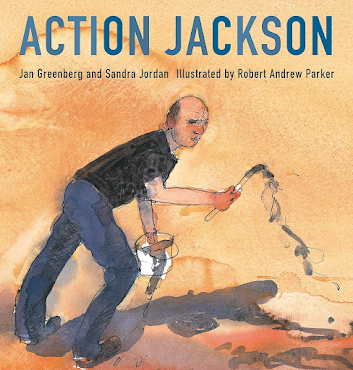


Greenberg, Jan and Sandra Jordan. 2007. Action Jackson. Squarefish. New York, NY. Ill by Robert Andrew Parker ISBN‎ 978-0312367510


PLOT SUMMARY


Action Jackson in a book that depicts the life of famous American artist and painter Jackson Pollock. Pollock would paint in his barn and create fascinating and unique works of art. He would use motion and movement as he painted on the floor. He would use regular house paint and often use his hands besides brushes. Some days he would take leisure walks to the beach, plant vegetable gardens at home, or cook dinner with his wife. His painting November 1, 1950 (Lavender Mist) is among his most recognized paintings. Pollock died in a car accident in 1956.


CRITICAL ANALYSIS


Action Jackson is a short biography about the life of Jackson Pollock. It includes glimpses of Jackson Pollock’s day by day routine, as well as his time creating his action packed paintings in his barn behind his home. The drawings show how much motion was created in his works, and how he would be inspired to move around his paintings as he added shapes, colors, and different objects. The book begins with Pollock as an adult, but at the end the author gives a detailed explanation about his life as a young boy, his first art pieces, his marriage, and his death.The book contains a bibliography and a detailed list of notes and references. It also has a picture of Pollock’s famous November 1, 1950 (Lavender Mist) art piece. The illustrator makes a wonderful use of colors and uses sensory description to show Pollock’s style of painting. The illustrator’s use of watercolors and uneven, somewhat unpolished drawings appear similar to Pollock’s abstract paintings.


REVIEWS


Booklist Starred Review:“'Action Jackson' was Jackson Pollock's nickname, and this slim, picture-book biography describes how this "athlete with a paintbrush" made one of his most famous works: the "drip painting" titled Lavender Mist. Using spare, lyrical words, the authors layer the exciting story with deep observations about what art is, how it is made, and why Pollock was so extraordinary-


Publishers Weekly Starred Review-“Nicknamed "Action Jackson '' for his kinetic style, abstract artist Jackson Pollock takes the spotlight in this outstanding picture book biography. Collaborators Greenberg and Jordan frame their account around a significant period in Pollack's life in 1950, when he created Number 1, 1950 (also called Lavender Mist), one of his most famous paintings. Readers follow Pollack into his barn studio, watch over his shoulder as he lays the canvas on the floor and begins to work all the while learning about his early life and influence”


Awards:

Sibert Honor Book
New York Times Best Book of the Year
Publishers Weekly Best Book of the Year.


CONNECTIONS

  • This book will appeal to those who like to learn about artists and painters.
  • This book will appeal to those who are creative and artistic.

Other related books:

Alvin Ailey by Andrea Davis Pinkney
When Marian Sang: The True Recital of Marian Anderson by Pam Munoz Ryan


Activity:

Have students use different types of colors, paints,and watercolors to create works of arts. Play jazz music during class and give each student a white paper. Have them create works of art.

***********************************************************************************


Quest for the Tree Kangaroo - An Expedition to the Cloud Forest of New Guinea
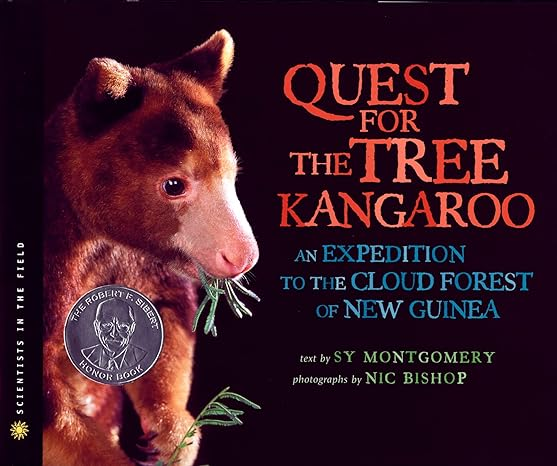


Montgomery, Sy and Nic Bishop.2006.Quest for the Tree Kangaroo: An Expedition to the Cloud Forest of  New Guinea. Houghton Mifflin Company. Boston, MA. ISBN 978-0547248929

PLOT SUMMARY


Quest for the Tree Kangaroo : An Expedition to the Cloud Forest of New Guinea describes the life of the Matschie’s tree kangaroos who live on trees in the cloud forests of New Guinea, a place that still remains unexplored in some regions. A scientist, an author, and a photographer, among a valuable team, embark on a journey throughout the forest in search of the tree kangaroo. The cute animal is described as having soft golden fur, a rounded face, a long thick tail, and a pink nose. This animal looks between the cross of a monkey and a bear and is considered one of the rarest animals of the planet. Since their habitat has been slowly destroyed and the animal has been hunted down, it makes it harder to find them. The scientist, Lisa Dabek, is determined to help these animals survive and decides to put trackers to follow the ones they capture before they are released back into the wilderness. Other rare and beautiful animals and plants are described and photographed in the expedition.


CRITICAL ANALYSIS


This is a detailed book about the animals Lisa Dabek, a creative scientist, and her team have seen in her expedition to New Guinea. Several other scientists, a veterinarian and even a zookeeper accompany Lisa in this journey. Each person present in this trip is described with background information of how they started their animal research. The author even gives a meticulous list of the items taken during their visit. The photographer, Nic Bishop, takes the most extraordinary photographs of the team, the surrounding areas, the villagers, and the animals they encounter. Each picture is given a caption. The book is a day to day recount of the team's visit; it is like a diary. A page in the book is dedicated to ways we can all follow to protect animals around the world. The author adds websites to learn more about animals and gives a glossary to translate words from Tok Pisin to English. An acknowledgment page and index is also included. Both the author and the photographer write a personal note about this exciting expedition.


REVIEW


Horn Book- “Montgomery's friendliness and curiosity set the tone...Bishop's photography is, as always, outstanding...Dabek's advice to young naturalists...[is a] useful addition.”


Booklist, ALA, Starred Review- “Another beautifully illustrated entry in the Scientists in the field series... Montgomery gives a chronological, sometimes moment-by-moment account of the challenging climb into the remote cloud forest...[giving] an unusually strong, visceral sense of the work and cooperation fieldwork entails and the scope and uniqueness of this particular mission...As usual, Bishop's color photographs are exemplary and extend the excitement in close-ups of creatures and of the team at work.”

Awards:

Sibert Honor Book

CONNECTIONS
  • For those who like to learn about unique animals around the world.
  • For those interested in conservation efforts to save animals.

Other related books:

The Tarantula Scientist by Sy Montgomery
Chameleon, Chameleon by Joy Cowley
The Tapir Scientist by Sy Montgomery

Activity:

Pair students and do research on the different animals photographed in the book. Make a brochure describing the animal, the place they live, what they eat, and how long they live for. Include pictures on the brochure.

Wednesday, June 26, 2024

Poetry


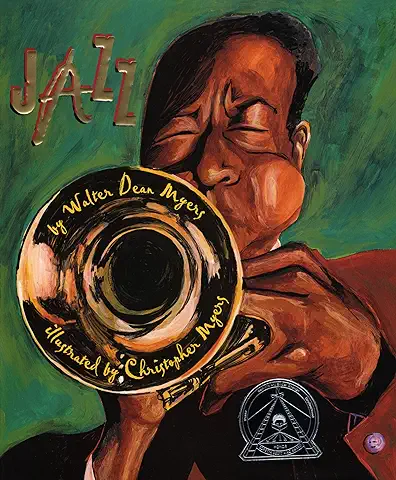
JAZZ


Myers, Walter Dean. 2006. Jazz. Ill. by Christopher Myers. Holiday House. New York, NY. ISBN 978-0823415458


PLOT SUMMARY

Jazz explores the same genre of music through a collection of poems. It depicts the life and cultural values of young African Americans. The poems show the vivid history of Jazz music. From exciting contagious rhythms to sad and pensive poems, Jazz celebrates deep emotions felt through jazz music.


CRITICAL ANALYSIS

Walter Dean Myers uses a collection of poems and rhythms throughout this book. The use of figurative language such an onomatopoeia is present in poems such as “Three Voices” where there is a “Thum, thum, thum” in the humming. There is repetition throughout the poems and these words are shown in different colors to highlight their importance. Musical instruments are shown in the illustrations; from trumpets, to trombones, to cellos. Each page has a colorful background that contrasts with the clothing worn by the different people shown in the pictures. The emotions of the people can be seen in their faces as they play the musical instruments or in their dancing moves. The book provides cultural respect to the African American community. The poems highlight famous African American musicians such as Louis Armstrong.


REVIEW EXCERPTS


Publishers Weekly Starred Review- “The father-and-son team behind blues journey creates a scintillating paean to jazz. Walter Dean Myers infuses his lines (and the rests between them) with so much savvy syncopation that readers can't help but be swept up in the rhythms.”


School Library Journal Starred Review- Grade 5-9–”Expanding on Blues Journey (Holiday House, 2003), this talented father and son have produced new poetry and paintings to explore a wider repertoire of jazz forms. An introduction provides historical and technical background, briefly touching on influences, improvisation, rhythm, and race. Spreads then pulsate with the bold, acrylic-and-ink figures and distorted perspectives that interpret the multiple moods and styles set forth in the text.”

Awards: Coretta Scott King Award Honor for illustration

ALA Notable Children's Book

Lee Bennett Hopkins Poetry Award

Publishers Weekly's 100 Best Books of the Year

Kirkus Reviews Editor's Choice

Booklist Editor's Choice

Booklist Top Ten in Black History

Book Link's Best New Books for the Classroom

Golden Kite Award: Picture Book Text


CONNECTIONS

● This book reminds us about the importance of our cultural traits and to add homage to our roots and traditions.


Other related books:

This Jazz Man by Karen Ehrhardt

Blues Journey by Walter Dean Myers

Harlem by Walter Dean Myers


Activity: Have students research the different kinds of music genres. In groups make presentations to the cultural contributions that music adds to a community.


***********************************************************************************

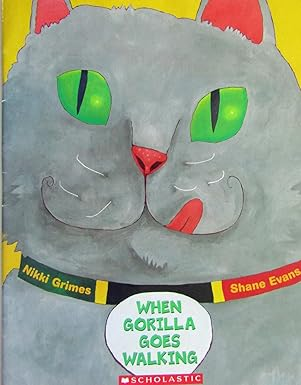
When Gorilla Goes Walking


Grimes, Nikki. 2007. When Gorilla Goes Walking. Orchard Books. Ill. by Shane Evans. New York, NY. ISBN 978-0439317702

PLOT SUMMARY

When Gorilla Goes Walking is a collection of poems spoken through the eyes of a young African American girl named Cecilia. She begins a special bond with a new cat pet she names Gorilla. Together they live everyday adventures and form a special and unique friendship. Gorilla, the gray cat, has a curious and feisty personality that is seen throughout the poem. Cecilia’s love for her pet cat is depicted in the book, especially when she is feeling blue about her best friend moving away. Cecilia finds comfort with Gorilla.

CRITICAL ANALYSIS

This book contains a set of poems that describe Cecilia’s and Gorilla’s everyday activities. Each poem begins with a new title that shows Gorilla’s actions throughout the day. The poem has a rhyming pattern and its playful language makes it entertaining. The pictures are vibrant and show Gorilla’s interesting personality. They show Gorilla painting, napping, walking, and even hissing at dogs nearby. Most of the poems have short lines that add to the actions of the characters. The vocabulary is simple and entertaining to read. Some of the poems are quatrains and there is also a haiku in the collection.

REVIEWS

Booklist: *Starred Review* In interlinked poems, Cecilia, a young African American girl, introduces her "cool cat,"---a fierce, tailless, gray shorthair named Gorilla. Written in a variety of forms, from rhyming couplets to haiku, the poems celebrate Gorilla's idiosyncrasies and "every cat" habits.


School Library Journal: Enormous, lively illustrations are paired with an equally bouncy text in this winning picture book. In a series of delightful poems, a girl introduces her cat, Gorilla, and describes her pet's many interests, talents, and behaviors.

CONNECTIONS

● This book will appeal to children who have a pet who they share a special bond with.

Other related books:
Won Ton: A Cat Tale Told in Haiku by Lee Wardlaw

Love That Dog by Sharon Creech

Dogku by Andrew Clements

Activity: Students will explore their creativity by writing a haiku about their own pets (or a pet they wish they had) and creating accompanying illustrations, inspired by "When Gorilla Goes Walking" by Nikki Grimes.

Display the pictures and poems on a bulletin board.

**********************************************************************************

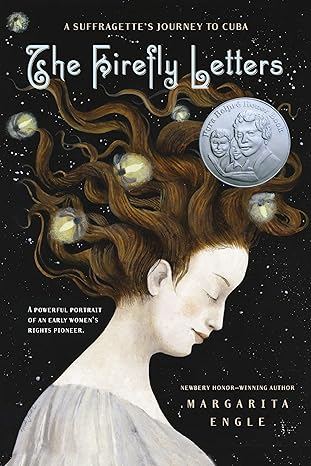
The Firefly Letters: A Suffragette’s Journey to Cuba


Engle, Margarita.2010. The Firefly Letters: A Suffragette’s Journey to Cuba. Squarefish. New York, NY. ISBN‎ 978-1250110961

PLOT SUMMARY

The Firefly Letters: A Suffragette’s Journey to Cuba is a historical novel written in verse about a Swedish writer named Fredrika who has traveled to Cuba to write about her observations of the people, especially the women. In Cuba she meets a translator, a young African girl named Cecilia. Cecilia is intelligent but her greatest aspirations are difficult to attain because she is a slave. Fredrika establishes her new home in Matanzas, a luxurious home where she meets Elena. Elena is the daughter of the wealthy landowner. Soon Elena becomes influenced by Fredrika’s progressive ideas about women’s rights and independence and learns that Cecilia should also have rights even if she is a slave.


CRITICAL ANALYSIS

The Firefly Letters: A Suffragette’s Journey to Cuba shows the perspective of three important characters: a writer, an African American slave, and a wealthy young lady.

The novel is written in a verse format which allows for a rhythmic and emotional narration. Each chapter is written through a different perspective; through the eyes of a different character. The main themes center around women’s rights and the lack of women’s independence during those times. The three character’s cultural backgrounds bring to a contrast in ideas and aspirations. Frederika represents knowledge, Cecilia resilience and hope, and Elena empathy.The author uses poetic language to explore important themes and present cultural diversity.

REVIEWS

Kirkus Reviews, starred review- “Like the firefly light, Engle's poetry is a gossamer thread of subtle beauty weaving together three memorable characters who together find hope and courage. Another fine volume by a master of the novel in verse.”

The Horn Book- “The imagistic, multiple first-person narrative works handily in revealing Bremer, an alert and intelligent woman in rebellion against her background of privilege.”

Booklist- “Through this moving combination of historical viewpoints, Engle creates dramatic tension among the characters, especially in the story of Elena, who makes a surprising sacrifice.” -

Awards:

A Pura Belpré Honor Book

An American Library Association Notable Children's Book

A Bank Street Best Children's Book of the Year


CONNECTIONS

● This novel will appeal to students who want to learn about women’s suffrage and the struggle that many women had to endure to find independence.

● This novel will create class discussion about slavery and the impact it had on both men and women.

Other related books:

Inside Out & Back Again by Thanhha Lai

The Red Pencil by Andrea Davis Pinkney

Witness by Karen Hesse

Activity: Students will research the historical setting of 19th-century Cuba, the life of Fredrika Bremer, and slavery in Cuba. Have students form groups and do a powerpoint presentation to share their findings in class.

Students can choose one of the main characters and write a journal entry written in the character’s perspective sharing their feelings and deepening our understanding of the character.

***********************************************************************************

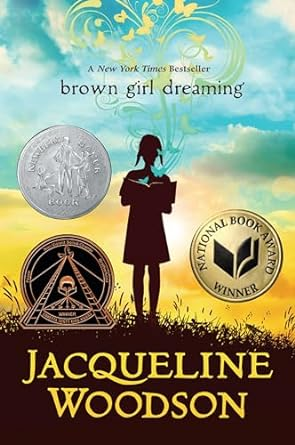
Brown Girl Dreaming


Woodson, Jacqueline. 2016. Brown Girl Dreaming. Nancy Paulsen Books. New York, NY. ISBN 978-0147515827


PLOT SUMMARY

Brown Girl Dreaming is a memoir written by Jacqueline Woodson that describes the life of a young African American girl during the 1960s and 1970s. In this powerful memoir she recounts her experience of living in South Carolina and then moving to New York City. Jacqueline finds the move difficult, and often remembers happy memories of her afternoons playing outside in South Carolina. New York City is different, and it takes her time to adjust. Jacqueline describes her siblings and how she was different and unique from them; always imaginative and curious. She often imagined things and would make up stories to pass the time. She shares her emotions and how the changes in her life led her to become a prolific writer.

CRITICAL ANALYSIS

Brown Girl Dreaming is a personal memoir written in verse that shares the deep emotions felt by a young girl who experiences changes in her life at a young age. During the time of moving to a new place to live she realizes she is different from her siblings, and often makes up stories. Sometimes her mother worries that she lies about things, but it is her curiosity and inquisitiveness that lead her to pretend and create these stories. She struggles to feel that she belongs. Through her book, Woodson shows her family’s life during a significant historical time for African Americans. The importance of her family and the bond they share show the role they play in her life. The narrative, imagery, and first person perspective of the book makes it a touching story. Common themes shared in the story are finding one's own identity and discrimination and segregation.


REVIEW

Kirkus Reviews, STARRED REVIEW- “Woodson cherishes her memories and shares them with a graceful lyricism; her lovingly wrought vignettes of country and city streets will linger long after the page is turned. For every dreaming girl (and boy) with a pencil in hand (or keyboard) and a story to share.”

The Horn Book, STARRED REVIEW- “A memoir-in-verse so immediate that readers will feel they are experiencing the author’s childhood right along with her. . . . Most notably of all, perhaps, we trace her development as a nascent writer, from her early, overarching love of stories through her struggles to learn to read through the thrill of her first blank composition book to her realization that ‘words are [her] brilliance.’ The poetry here sings: specific, lyrical, and full of imagery. An extraordinary—indeed brilliant—portrait of a writer as a young girl.”

Awards:

A National Book Award Winner

A Coretta Scott King Award Winner

A Newbery Honor Book

One of TIME MAGAZINE’s 100 Best YA Books of All Time


CONNECTIONS

● For anyone who has moved from one place to another and feels out of place and uncertain with changes.

● For those that can relate to writing deep thoughts and feelings about one's personal life.

● For those interested in learning more about a time in America with segregation and discrimination.


Other related books:
Finding Miracles by Julia Alvarez

Summer of the Mariposas by Guadalupe Garcia McCall

Other Word for Home by Jasmine Warga


Activities:

Have students write a short memoir describing life in their family. Specify the traits shared with family members and relate what makes you similar, but also different to each other.

Thursday, June 13, 2024

Traditional Literature

The Tortoise and the Hare 


BIBLIOGRAPHY 

Pinkney, J. 2013. K. The tortoise and the hare. Ill. by Jerry Pinkney. Little, Brown and Company. New York, NY. ISBN 978-0316183567 


PLOT SUMMARY 

The Tortoise and the Hare is a story that has been shared by many generations. A group of animals in the desert are about to experience a race between two quite distinct animals, a tortoise, and a hare. As the race begins, we see the hare taking the lead using all its energy. On the other hand, the tortoise takes its time, stopping and even communicating with the animals he meets along the way. As hare realizes he is much ahead of tortoise, it decides to take a quick break and munch on some lettuce he finds along the path. He finds a soft, comfortable place and dozes off to sleep. Hare continues the journey slowly and steady. Much to Hare’s dismay, Tortoise finishes the race before him. 


CRITICAL ANALYSIS 

Pinkney retells a story told through many generations with a powerful theme, it is better to take your time than to rush to do things. The tortoise and the hare symbolize basic human traits which are those who are constant like tortoise and those who are inconsistent like hare. The few words written in the book, “slow and steady,” are repeated throughout the story. The words echo the message of being reliable. Although the setting of the story is in the desert which is covered by neutral tones, the illustrations are vibrant with colors. The clothing the animals in the story wear are vibrant and vivid as are the growing flowers of the cactus. The animals’ bodies are detailed with lines and squares to create rough skin and prickly cacti and swift brushstrokes to form soft fur. A personal statement shared by the author in a final note was his own struggle with dyslexia and the need for him to start over and steady many times. 


REVIEW EXCERPTS 


Publishers Weekly, starred review - "Pinkney's magnificently illustrated version of this famous fable gives the race the excitement of an Olympic event." 
 

Kirkus  With luminous mixed media pictures, a short, carefully meted-out text and a Southwestern U.S. setting, Pinkney (The Lion and the Mouse, 2009) takes on another of Aesop’s fables—marvelously. 


CONNECTIONS 


  • This book reminds us that challenging work takes consistency and perseverance, and that when we do things in an unpredictable way and lose focus of our goals, we can lose ground. 


Other related books: 

  • Strega Nona by Tomie dePaola 

  • Flight School by Lita Judge 

  • Salt in His Shoes: Michael Jordan in Pursuit of a Dream by Deloris Jordan and Roslyn Jordan 


Activity: Have a class discussion of an event where the students had to give all their effort to get something done and how they felt after reaching their accomplishment. 


Turtle's Race with Beaver 

Turtle's Race with Beaver 

Bruchac, J. & Bruchac, J. 2003. Turtle's race with beaver.   Ill. by Jose Aruego and Ariane Dewey. New York, NY. Dial Division. ISBN 978-0142404669 


PLOT SUMMARY 

Turtle's Race with Beaver is a retelling of a favorite Native American folktale about two animals who compete with one another to see who can win a race by showing off their abilities. Turtle lives peacefully in a pond where it spends the best summer days basking in the warm sun. As winter approaches, she decides to bury herself in the mud and prepare for hibernation. As months pass and Turtle awakes, it realizes someone else has made this habitat its home. Realizing a beaver has accommodated itself in the pond, Turtle tries to share the pond to no avail. The animals decide to compete for the pond. Whoever wins a swim race across the pond will be the winner. Turtle knows he is a slow swimmer and may not have the physical strength as Beaver, but soon realizes his mental abilities are sharper than ever. 


CRITICAL ANALYSIS 

A folktale passed down through oral traditions for centuries amongst the Northeastern Woodland peoples. In this version the beaver resembles a powerful and physically strong individual. Contrary to this character, the turtle represents those without physical strength, but with a great ability to solve problems and use their thinking skills. Towards the middle of the story the animals tell each other the situation of the events happening, just like these folktales were passed amongst the people. The author repeats chants in bold letters to show the animals' excitement during the race. Figurative language, such as onomatopoeia is used as the characters begin the competition.  

The illustrations are lively and colorful, adding excitement to the story. The splashing scenes in the book show the tension between the two animals as they prepare to win the race.  


REVIEW EXCERPTS 


Kirkus- “The artists’ trademark energy-filled pen-and-ink and gouache illustrations enhance the tale with color and humor. Each animal bursts with personality in this sure winner." 

Booklist- “A clever twist and a final bit of psychological realism give this variant on a Seneca Indian “Tortoise and Hare” tale unusually broad audience appeal. 


CONNECTIONS 

  • This story is great for class discussion about how not everything can be achieved by physical strength. Sometimes taking things slowly and pondering how to solve a problem is a superior way to achieve a goal. 


Other related books: 

  • The Tortoise and the Hare by Jerry Pinkey 

  • Give up, Gecko! by Margaret Read Macdonald 


Activity: Have students choose two animals and draft a short story about how the weaker animal proves victorious by using his thinking skills instead of his physical abilities. 


The Three Swingin’ Pigs 


Rubin, V. 2007. The three swingin’ pigs. Ill.by Rhode Montijo. New York, NY. Henry Holt and Company. 978-0805073355 


PLOT SUMMARY 

Satch, Mo, and Ella are three talented singing pigs who perform all over the country. However, Wolfie is not too fond of them because they left his uncle ridiculed sometime in the past. Wolfie wants to show up to one of the pigs’ performances and finish them up. Wolfie appears at the Littlepiggie Hall, but the smart pigs realize he is in the audience, and that he has vicious plans. They invite him to sing up on stage, and for the first time Wolfie realizes how fun it is to entertain a live audience. The three clever pigs convince Wolfie to change his plan.  


CRITICAL ANALYSIS 

This folktale is an adaptation from the Three Little Pigs which has been told for many generations. In this story the author uses a different setting to city life and changes the characters’ perspectives. Instead of being three defenseless pigs, these characters appear confident and clever. The three little pigs are jazz players who perform across the country. The author creates rhythm with the beats of the music. Repetition is used throughout the story to emphasize the tunes of the music. A constant “scat-scooby-dooby, skit-scat-skedoodle, shoooo!” and a “wee-wee-wee-wee!” are recurring in the story.  

The illustrator uses bright, vivid colors throughout the story. Purples, oranges, dark pinks, and yellows pop to show more action. Wolfie’s bad breath is shown in a neon green color scattered through the scenes. In some scenes the illustrator recalls two other favorite folktales Little Red Riding Hood and Little Bo Peep. 


REVIEW EXCERPTS 


Kirkus starred review- “Montijo's red-hot pictures and Rubin's skit-scat-skedoodle words make this take-off a hand-clapping, foot-stomping romp.” 


School Library Journal -“Kids should get a kick out of this hip riff on an old standard.” 


CONNECTIONS 

  • This story is great for class discussion about how we can form a negative opinion about someone, but when we get to work with them, we realize we were mistaken or judged others without having any reason.  


Other related books: 

  • The Three Ninja Pigs by Corey Rosen Schwartz 

  • The Three Little Bass and the Big Bad Gar by James R. Miller 


Activities: Have students form groups to create their own version of the Three Little Pigs using different settings to the story and changing the characters work or profession to give it a twist.  

This story can also be used as a reader’s theater activity where the students make up the voices of the characters. 


A Cloak for the Moon 


Kimmel, E. A. (2001). A cloak for the moon. Ill. By Katya Krenina. New York, NY. Holiday House. 978-0823414932. 


PLOT SUMMARY 

This folktale is retold from Rabbi Nachman of Bratslav. Haskel, a tailor, spends his days sewing beautiful clothes and his nighttime admiring the moon. In a dream, the moon tells him that she gets cold at night and would love for him to make her a cloak to cover her. Haskel is determined to find a special fabric that can expand and contract to fit the needs of the moon. He travels the world to keep his promise. As he continues his journey, he meets a queen who is anxiously concerned about her daughter not being able to get married because the royal wedding dress, made from beams of light, cannot be fixed. Haskel begins to work through the night on the wedding gown discovering that the secret to mending it is to work at night while the magical garment is woven with threads of light from the moon. 


CRITICAL ANALYSIS 

A Cloak for the Moon is a tale that combines folklore with the author’s imagination. The story is centered in a distant village where the characters follow superstition and magical stories. The main character, Haskel, follows his dream in this vivid journey across the land. Some common themes in the story are the importance of perseverance and selflessness. Each character is developed with its own conflicts and narrative. Haskel will do anything in his power to keep his promise to the moon while the queen will do anything for the princess’s happiness.  

Through the illustrations, cultural traditions and costumes are observed. We can recognize detailed pictures of rich attire and textures, as well as distinct backgrounds and scenery. The drawings show arid deserts, luscious forests, and rapid, raging rivers.  


REVIEW EXCERPTS 


Goodreads-”This is a beautiful and enchanting tale; the illustrations are terrific, and the narrative is filled with interesting twists and turns.” 

Kirkus- Kimmel identifies his source as one of the mystical tales of Rabbi Nachman, without further elaboration on the tale itself. While not obviously reflective of its Hasidic roots, the retelling is satisfying both as a story of devotion and determination and as a magical look at the nature of light.” 


CONNECTIONS 

  • This story can be used for a class discussion about what some of our dreams are and how we can work to achieve them.  


Other related books: 

  • Imani’s Moon by Janay- Brown Wood 

  • Rumpelstiltskin by The Brothers Grimm 


Activities: Invite students to imagine an alternate ending for the story or to write a sequel exploring what happens to the characters after the events of the book. This activity encourages creativity and allows students to practice their writing skills. 

Have students create illustrations or artwork inspired by scenes from the book. They can use various mediums such as drawing, painting, or collage to bring the story to life visually. Display the artwork in the classroom to enhance the learning environment. 


Asian American Literature

  Tea with Milk Say, Allen. 2009. Tea with Milk . Clarion. New York, NY. ISBN 978-0547237473 PLOT SUMMARY Masako, known as May to her friend...